Windmill vs n8n: open-source workflow automation and internal tools for a Next.js SaaS (2026)
A developer-lens 2026 comparison of Windmill and n8n: code-first engine vs visual automation canvas, the AGPL vs fair-code license split, execution-metered pricing, and which one fits a Next.js SaaS.
Updated on August 12, 2026
On this page
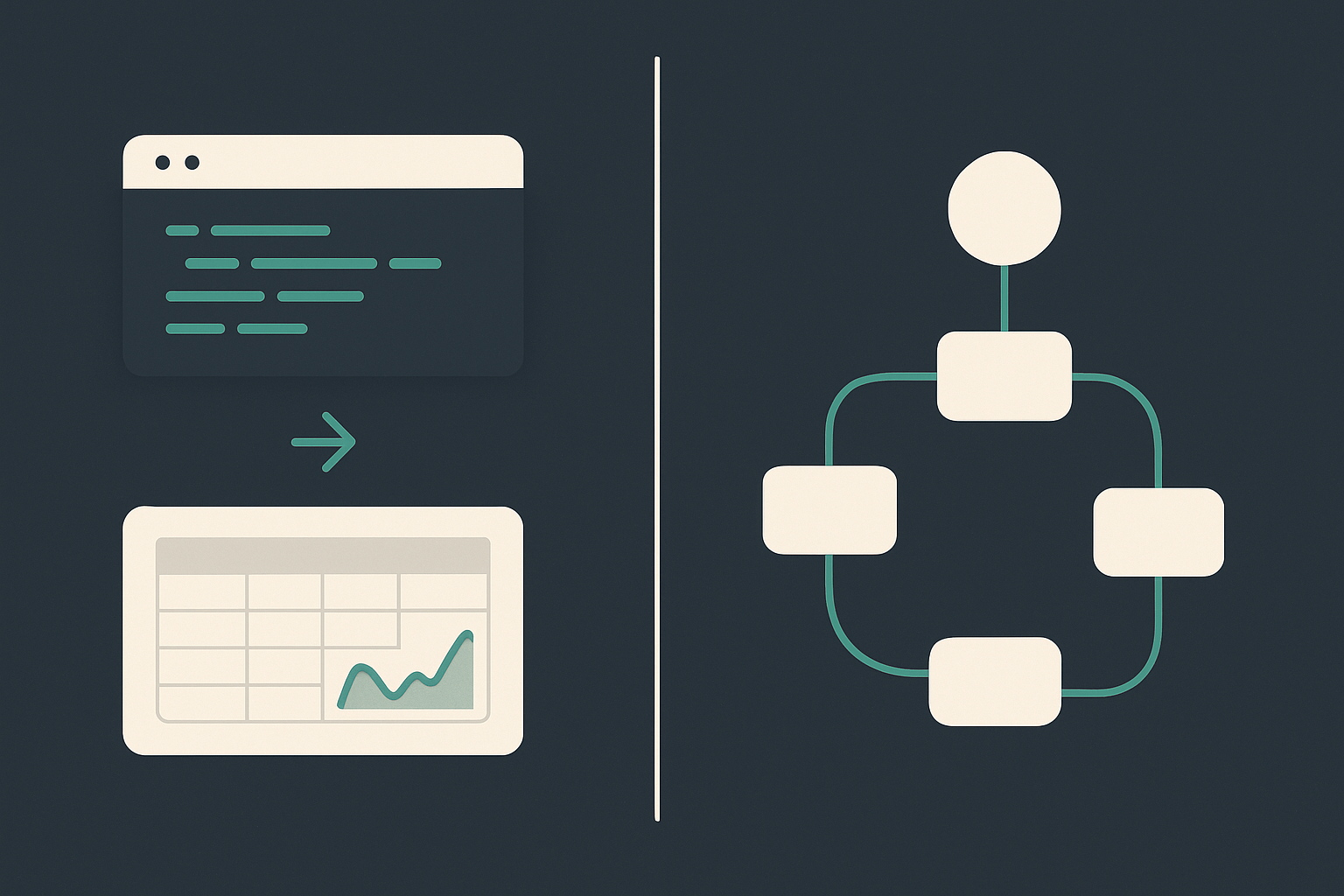
Every "open-source Zapier" thread eventually turns into a Windmill versus n8n argument, and the two tools get lumped together as if they were interchangeable. They are not. We self-host both next to a Next.js SaaS, and the honest read is that they solve overlapping problems from opposite ends: n8n is a visual automation platform your whole team can wire up, and Windmill is a code-first engine that turns scripts into workflows and internal UIs. The license terms, the pricing model, and the fit with a Next.js codebase all diverge more than the marketing pages admit. Here is how they actually compare in 2026.
Quick answer (August 2026)
Pick n8n if you want a visual, node-based automation canvas with a huge integration library (400+ connectors, 9,000+ templates) and native AI/agent nodes, and you are comfortable with its fair-code license. Pick Windmill if your team writes code, wants a genuinely open-source (AGPL-3.0 or Apache-2.0) engine, and needs to turn Python/TypeScript/Go scripts into fast workflows and internal tool UIs. Neither one compiles into your Next.js app; both run as a separate self-hosted service beside it, and you integrate at the data, webhook, and API layer. n8n has vastly more mindshare (~200k GitHub stars versus Windmill's ~17.5k) and the friendlier on-ramp for non-developers. Windmill is the leaner, faster, more code-native option, and the only one of the two that is OSI open-source. The real decision is who builds and owns your automations: a mixed team on a visual canvas, or engineers writing scripts they version in Git.
The 30-second version
Scroll to see more
| If you are... | Better pick | Why |
|---|---|---|
| A mixed team (ops, marketing, devs) wiring SaaS apps together | n8n | Visual canvas, 400+ integrations, non-devs can build and audit flows |
| An engineering team that would rather write scripts than drag nodes | Windmill | Code-first in Python/TS/Go/Bash, Git-native, generates UIs from script params |
| Building AI agents and LLM chains with prebuilt nodes | n8n | Native AI/LangChain agent nodes and a large template gallery |
| Needing a true OSI open-source license for internal tooling | Windmill | Dual AGPL-3.0 / Apache-2.0; n8n is fair-code (source-available), not OSI |
| Turning backend scripts into internal admin UIs | Windmill | Auto-generates a UI from script parameters; a real Retool alternative |
| Planning to offer the tool as a service to your own clients | Read the license | n8n's Sustainable Use License restricts this without a commercial license |
What Windmill is

windmill-labs/windmill, roughly 17.5k GitHub stars as of August 2026) is an open-source developer platform that turns scripts into webhooks, workflows, and UIs. You write a script in Python, TypeScript, Go, Bash, SQL, or several other languages, and Windmill can auto-generate a frontend form from its parameters, compose it into a multi-step flow, and trigger it on a schedule, a webhook, an HTTP route, Kafka, or email. The backend is written in Rust, the app builder frontend in Svelte, and it stores state in PostgreSQL. The project advertises a workflow engine "13x faster than Airflow," which lines up with the code-native, low-overhead design.
The mental model that matters: Windmill is closest to a self-hostable fusion of a workflow engine and an internal-tool builder. If your requirement is "turn this Postgres query and this Python function into an admin screen my ops team can use," that is Windmill's sweet spot, and it puts Windmill in the same conversation as the tools in our open-source Retool alternatives guide. It is aimed squarely at developers: you get the most out of it when your builders are comfortable writing and versioning code.
What n8n is

n8n-io/n8n, roughly 200k GitHub stars as of August 2026) is a fair-code platform for building automations and AI agents on a visual, node-based canvas. You connect nodes, one per app or action, into a flow, and n8n handles the plumbing between them. It advertises 400+ integrations (1,500+ counting community nodes), 9,000+ workflow templates, and a set of native AI and LangChain nodes for building multi-step agents. It is a TypeScript and Node.js project, and the star count reflects genuinely enormous mindshare: n8n is one of the most popular self-hosted automation tools in the world right now.
The mental model here: n8n is the open-ish, self-hosted answer to Zapier and Make, extended in 2025 and 2026 into AI-agent territory. Its strength is breadth. When the job is "watch this inbox, enrich the lead, write it to the CRM, ping Slack, and let a non-engineer maintain that flow," n8n's canvas and connector library are hard to beat. You can drop into code nodes when you need to, but the point is that you mostly should not have to.
The Next.js and Vercel fit lens
This is the part every generic comparison skips, and it decides the tool for our readers. Both Windmill and n8n are persistent, stateful services with their own databases. That has one blunt consequence for a Next.js team.
- Neither one deploys to Vercel serverless, and neither becomes part of your Next.js build. You run it as a sibling service, in its own container or VM, next to your app. If you were hoping to
npm installa workflow engine into your Next.js repo, that is not the shape of either tool. For in-repo background jobs that do live inside a Next.js deploy, the libraries in our Next.js background jobs comparison are the closer fit. - You integrate at the data, webhook, and API layer. Your Next.js app calls a Windmill HTTP route or an n8n webhook, they call back into your API, and everything shares the same database and auth boundary. This is the same integration pattern you would use for a standalone admin builder, and it is genuinely clean once you accept that the automation layer is a separate deployment.
If the tool you actually want lives inside your product, same repo and same deploy and same design system, then a code-first library such as Refine is the better call, because it compiles into the Next.js app. Windmill and n8n are the answer when the automation or the internal tool is a separate back-office surface, not a customer-facing screen.
The license question nobody reads carefully
This is the single biggest difference the marketing pages soften, and it is worth stating precisely.
- Windmill is OSI open-source. The project is dual-licensed under AGPL-3.0 and Apache-2.0 as of 2026. Self-hosting for any purpose, including inside a commercial product, is permitted under those licenses. The usual AGPL network-copyleft caveat applies only if you distribute a modified version over a network, which most internal deployments never trigger.
- n8n is fair-code, not open-source. It ships under the Sustainable Use License (plus a separate Enterprise license), which n8n itself labels "source-available," not OSI open-source. Per n8n's license terms (2026), you can self-host and use n8n internally for your own business for free, and you can modify it. What you cannot do without a commercial license is offer n8n as a hosted service to third parties or embed it into a product you sell to clients.
For most teams building internal automations behind their own firewall, both are effectively free and the distinction is academic. But if you are an agency planning to spin up n8n instances for clients, or a SaaS planning to white-label a workflow builder into your product, that Sustainable Use License clause is exactly the scenario it is written to restrict, and Windmill's AGPL-3.0/Apache-2.0 dual license is the more permissive path. Read it before you build on it.
Pricing: unlimited self-hosted executions versus metered cloud runs
Both tools are free to self-host. The paid tiers differ in shape.
Windmill (pricing, 2026):
- Free and self-hosted, $0: unlimited executions, up to 50 users total (SSO capped at 10), 3 workspaces, 10 GiB object storage, community support. No audit logs or SAML.
- Enterprise, from $120/mo: priced per seat and per compute, roughly $20 per developer, $10 per operator, and $100 per two standard workers, with unlimited workspaces, SSO, audit logs, and SAML/SCIM.
n8n (pricing, 2026):
- Self-hosted Community Edition, $0: free, unlimited executions, on your own infrastructure.
- Cloud Starter, €20/mo (billed annually): 2,500 workflow executions.
- Cloud Pro, €50/mo: 10,000 executions.
- Cloud Business, €667/mo: 40,000 executions, plus SSO and other governance features.
The metering model is the thing to internalize: n8n Cloud charges by workflow execution, defined as one run of the entire workflow regardless of how many steps or how much data it processes. That is genuinely generous compared with per-step or per-task competitors, but it is still a cap, and busy automations climb the tiers quickly. Windmill's paid model is seat-plus-compute rather than per-execution. If you self-host either tool, executions are unlimited and free on both; the pricing question only bites if you want the vendor to host and support it.
Head-to-head: where each one wins
Scroll to see more
| Dimension | Windmill | n8n |
|---|---|---|
| Build model | Code-first (write scripts, auto-UI) | Visual node canvas |
| Best builder | Engineers | Mixed and non-technical teams |
| License | AGPL-3.0 / Apache-2.0 (OSI open-source) | Sustainable Use License (fair-code, source-available) |
| Integrations | Fewer prebuilt; you write connectors | 400+ prebuilt (1,500+ with community) |
| AI / agents | Scriptable; bring your own | Native AI and LangChain agent nodes |
| Internal-tool UIs | Yes, generated from script params | Limited; automation-first |
| Engine | Rust, "13x Airflow" performance claim | Node.js |
| Mindshare | ~17.5k stars | ~200k stars |
| Self-hosted executions | Unlimited, free | Unlimited, free |
The pattern is consistent. Windmill trades ecosystem breadth for code-native speed, a real open-source license, and internal-tool UI generation. n8n trades some code purity for an unmatched integration library, a gentler learning curve, and first-class AI-agent tooling. Neither is strictly better; they are optimized for different builders.
When to choose Windmill
- Your builders write code and would rather commit a Python or TypeScript script than assemble a visual flow.
- You want the automation engine and the internal admin UI from one self-hosted, genuinely open-source tool.
- You care about the license because embedding-in-a-product or serving-clients is on your roadmap.
- Raw throughput matters and you like the Rust-engine performance posture.
When to choose n8n
- You have a mixed team, and non-engineers need to build, read, or audit automations.
- The job is mostly connecting existing SaaS apps, where a 400+ connector library saves real weeks.
- You are building AI agents or LLM workflows and want prebuilt, maintained nodes rather than hand-rolled glue.
- You are fine with fair-code for internal use and are not reselling n8n as a service.
The bottom line
Windmill and n8n get compared because they overlap in the middle, but they are built for opposite users. n8n is the visual, integration-rich, AI-agent-ready automation platform for a whole team, and its ~200k stars are earned. Windmill is the code-first, truly open-source engine that doubles as an internal-tool builder for developers who live in an IDE. For a Next.js SaaS, remember the two facts the marketing pages gloss: neither runs inside your app, so you deploy it as a sibling service, and only one of them is OSI open-source, which matters the moment your plans involve clients or embedding. Match those to your team and your roadmap, and the pick makes itself.
Sources
- Windmill GitHub repository, license, stack, and stars: github.com/windmill-labs/windmill (accessed August 2026)
- n8n GitHub repository, license, integrations, and stars: github.com/n8n-io/n8n (accessed August 2026)
- n8n Sustainable Use License terms: docs.n8n.io/sustainable-use-license (2026)
- Windmill pricing and tiers: windmill.dev/pricing (August 2026)
- n8n pricing and execution metering: n8n.io/pricing (August 2026)

Written by
Yui TanakaYui Tanaka curates the ShipGarden gallery, where we test open-source building blocks so we can own the stack that funds the life.
Frequently asked questions
Is Windmill open source?
Yes. Windmill is dual-licensed under AGPL-3.0 and Apache-2.0 as of 2026, which are OSI-approved open-source licenses. You can self-host it for free with unlimited executions (up to 50 users, 3 workspaces on the free tier), and use it inside a commercial product. The only AGPL caveat is if you distribute a modified version over a network, which most internal deployments never trigger.
Is n8n open source, and can I use it for free commercially?
n8n is fair-code, not OSI open-source. It ships under the Sustainable Use License, which n8n labels source-available. You can self-host it and use it internally for your own business for free, and you can modify it. What you cannot do without a commercial license is offer n8n as a hosted service to third parties or embed it into a product you sell to clients.
Does Windmill or n8n run inside a Next.js app?
Neither. Both are persistent, stateful services with their own databases, so you deploy them as a separate sibling service next to your Next.js app rather than inside your build or on Vercel serverless. You integrate at the data, webhook, and API layer: your app calls their HTTP routes or webhooks and they call back into your API over a shared database and auth boundary.
Which is better for internal tools versus connecting apps?
Windmill is stronger for internal tools: it turns Python, TypeScript, or Go scripts into UIs automatically, which makes it a real Retool alternative for developer teams. n8n is stronger for connecting existing SaaS apps, thanks to 400+ prebuilt integrations (1,500+ with community nodes) and a large template gallery, and non-technical teammates can build and audit flows on its visual canvas.
Which handles AI agents better, Windmill or n8n?
n8n, out of the box. It ships native AI and LangChain agent nodes plus thousands of templates for multi-step agents and LLM chains. Windmill can build agent logic too, but you write it as scripts and bring your own model integrations rather than dragging prebuilt nodes.
More from the garden

Inngest vs Trigger.dev vs BullMQ: Next.js Background Jobs (2026)
Inngest, Trigger.dev, and BullMQ for Next.js background jobs in 2026: where each runs, real pricing, honest 'where it loses', and how to pick.
Node.js workflow engine or job queue? BullMQ, pg-boss, Trigger.dev, Hatchet, Temporal and Inngest (2026)
Most people searching for a Node.js workflow engine are holding two problems at once. We split the shelf along that seam: job queues (BullMQ, pg-boss) on one side, workflow engines with durable execution (Hatchet, Trigger.dev, Temporal, Inngest) on the other, and the test that tells you which one you need.

Refine vs React-Admin vs AdminJS: the open-source admin panel for a Next.js SaaS (2026)
Refine, React-Admin, and AdminJS are the three open-source ways to add an admin panel to a Next.js SaaS in 2026. We compare architecture, deploy path, real cost, and where each one loses.