ToolJet review: the open-source Retool alternative for Next.js internal tools (2026)
A hands-on 2026 review of ToolJet, the open-source (AGPL-3.0), self-hosted low-code builder for internal tools. What you actually get for free, the AI credit pricing, the license trap, and whether it fits a Next.js SaaS.
Updated on August 10, 2026
On this page
ToolJet keeps showing up in every "open-source Retool alternative" thread, and in 2026 it wears a new label: ToolJet AI. We run our own stack on Next.js and self-host what we can, so the question we actually care about is narrower than "is ToolJet any good." It is this: does ToolJet earn a place next to a Next.js SaaS, and what do you really get for free? We spun it up, read the license, and priced out the AI. Here is the honest read.
Quick answer (August 2026)
ToolJet is a self-hosted, open-source (AGPL-3.0) low-code builder for internal tools such as admin panels, back-office dashboards, and ops consoles. You run it as its own service and point it at your existing database. It is one of the strongest Retool alternatives when your requirement is "self-host it, keep the data in-house, build faster than a hand-rolled React admin." Two caveats decide the call for a Next.js team. First, ToolJet does not compile into your Next.js app or run on Vercel serverless; it is a separate Node and React server you host beside your app. Second, the genuinely free path is the self-hosted Community Edition (a limited feature set), while the headline AI generation runs on metered credits that are thin on the free cloud tier. If you want an internal tool that lives inside your product's codebase, a code-first library fits better. If you want a standalone ops UI over your Postgres, ToolJet is a real answer.
The 30-second version
Scroll to see more
| If you are... | ToolJet fit | Why |
|---|---|---|
| A team wanting a self-hosted admin panel over an existing DB | Strong | Open-source CE, Docker/Kubernetes, connects to your Postgres and APIs |
| A solo dev who wants the tool inside the Next.js repo | Weak | ToolJet is a separate server, not an in-app library |
| Evaluating the free tier's AI generation | Read the credits | Free cloud gives 100 AI credits per month, no top-ups |
| Shipping a modified build to customers over a network | Read the license | AGPL-3.0 network copyleft applies |
What ToolJet actually is

ToolJet/ToolJet, roughly 38.3k GitHub stars as of August 2026, AGPL-3.0) is a JavaScript and TypeScript project on Node.js and React. In 2026 the project brands itself as "the open-source foundation of ToolJet AI," an AI-native platform for building internal tools, workflows, and agents.
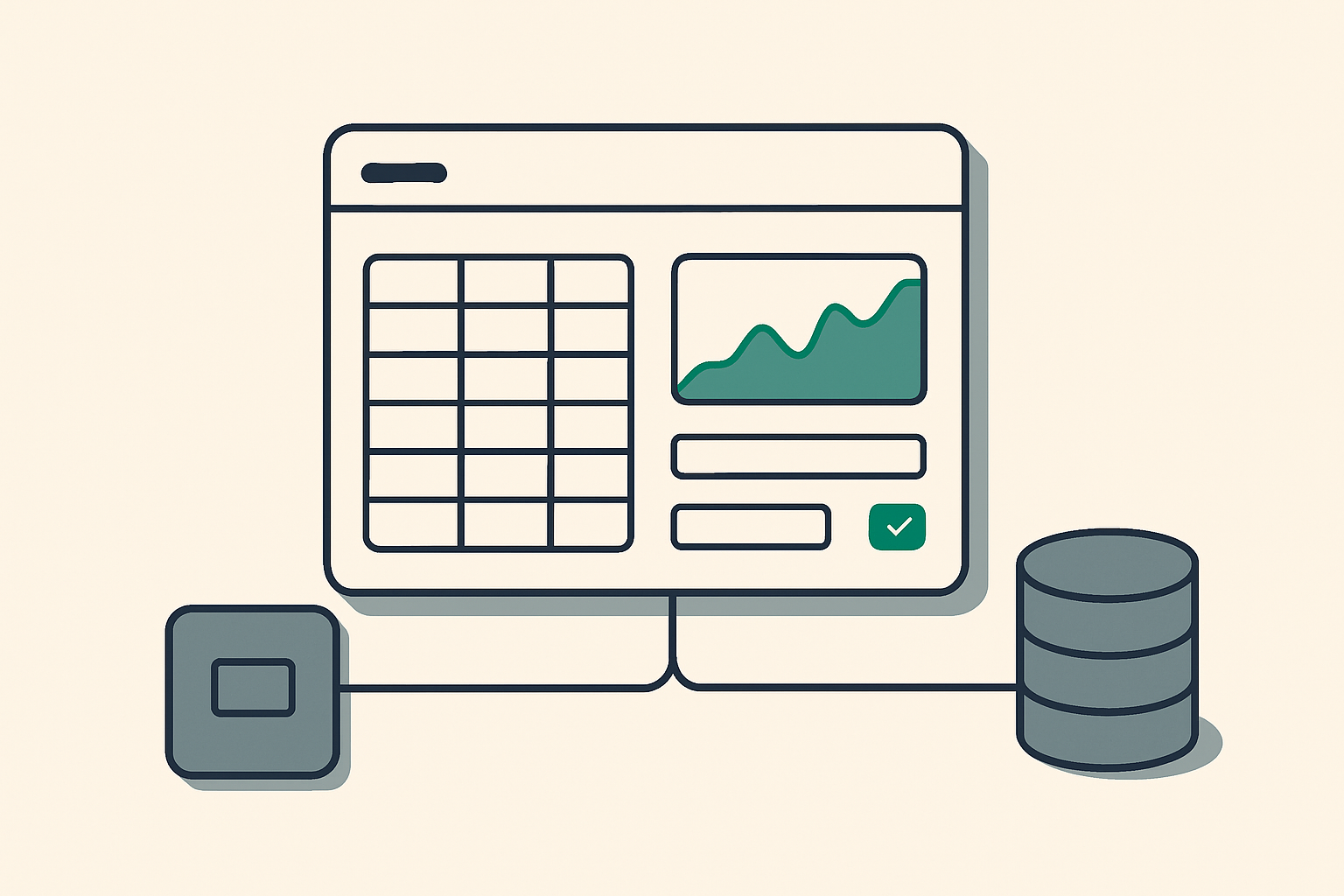
The mental model that matters: ToolJet is a server you host, not a component you import. You deploy it (Docker, Kubernetes, Helm, or a managed cloud), give it access to your data sources, and your team builds apps inside its editor. Those apps are served by ToolJet, behind ToolJet's auth, at ToolJet's URL. They do not live inside your Next.js routes.
The Next.js and Vercel fit lens
This is the part most round-ups skip, and it is the one that decides the tool for our readers. ToolJet is a persistent Node and React application with its own PostgreSQL database (and a Redis cache). That has two consequences.
- It does not deploy to Vercel serverless, and it does not become part of your Next.js build. You run it as a sibling service, in its own container or VM, next to the app.
- You integrate at the data and auth layer, not the code layer. ToolJet talks to the same database and APIs your Next.js app uses, and you gate it behind SSO. If you wanted the tool to live inside your product (same repo, same deploy, same design system), a code-first admin library like Refine is the closer fit, because it compiles into the Next.js app. ToolJet is the better answer when the internal tool is a separate back-office surface your ops team uses, not a customer-facing screen.
What you actually get for free (the CE vs AI reality)
"Open source" and "free" are not the same line here, and the 2026 AI pivot muddies it, so let us be precise.
- Self-hosted Community Edition: free, open-source, AGPL-3.0. You host it and you get the visual builder, the connectors, and the datastore. ToolJet describes the CE as a limited feature set relative to the paid tiers; the richest AI and enterprise-governance features sit upstream.
- ToolJet Cloud (hosted): AI generation (App Generation, Query Generation, Auto-fix and Debugging) is offered across the tiers, but it is metered by AI credits, per ToolJet's pricing (2026):
- Free, $0/mo: 2 builders, 50 end users, 2 apps, and 100 AI credits per month with no add-on credits.
- Pro, $79/mo: unlimited builders, 50 end users, 5 apps, 2,000 AI credits per builder per month.
- Team, $199/mo: unlimited builders, 100 end users, unlimited apps, 3,000 AI credits per builder per month.
- Enterprise, from $3,000/mo: unlimited users and apps, custom credit allocation.
The honest read: the free cloud tier's AI is a demo, not a daily driver. One hundred credits with no way to top up means you will try the AI builder, like it, and hit the wall inside a real project. If AI generation is the reason you are here, you are pricing the Pro or Team tier, or you are bringing your own model into the self-hosted CE. If you just want a hand-built admin panel without the AI, the self-hosted CE is genuinely free and does the job.
The license question nobody answers
ToolJet is AGPL-3.0, and that matters more than the usual "it's open source, ship it" hand-wave.
- An internal admin panel behind your firewall: AGPL is a non-issue. You use it, you do not distribute a modified version, and you are done.
- You fork ToolJet, modify it, and expose the modified version to users over a network: AGPL's network-copyleft clause obligates you to offer those users your modified source. For most teams building internal tools this never triggers. But if your plan was to fork ToolJet into a customer-facing product, read the license first, because that is the exact scenario AGPL is written for.
Compare that to the code-first tier: Refine is MIT and Appsmith is Apache-2.0, both more permissive if embedding-in-a-product is on your roadmap. We put ToolJet head-to-head with the other GUI builders in our Appsmith vs ToolJet vs Budibase breakdown.
Lock-in: JSON apps, not portable code
ToolJet apps are stored as JSON app definitions that run inside the ToolJet runtime. You are not generating a React codebase you can lift out and own; you are committing to ToolJet as the host. That is the standard trade for every GUI internal-tool builder (Retool, Appsmith, and Budibase all do a version of this), and it is fine as long as you know it going in. It is also the cleanest reason a code-first library wins when "we own every line" is a hard requirement.
Where ToolJet wins, and where it does not
Choose ToolJet when:
- You want a self-hosted internal-tools platform and data residency matters.
- Your builders are technical enough for a low-code editor, but you do not want them writing a React admin from scratch.
- You need to wire many data sources (Postgres, REST, GraphQL, cloud services) into one back-office UI fast.
Look elsewhere when:
- You want the tool inside your Next.js app and repo, which points to a code-first stack (Refine or React-Admin).
- You want the biggest widget library and the most advanced GUI capabilities; Appsmith is the heavier GUI builder, and ToolJet trades some breadth for a cleaner editor.
- You want no-code aimed at business users rather than developers; Budibase leans more that way.
- You are migrating off Retool specifically, in which case weigh the whole field in our open-source Retool alternatives guide.
Even ToolJet's competitors concede the shape of it: Refine's own comparison page frames ToolJet as working "well for basic internal tools with self-hosting requirements," which, stripped of the sales angle, is a fair description of its sweet spot.
The bottom line
ToolJet in 2026 is a solid, genuinely open-source, self-hostable internal-tool builder that earns its Retool-alternative reputation for back-office apps over your own data. For a Next.js SaaS team, hold two facts in your head before you commit. It runs as a separate service, not inside your app, and the free tier's AI is trial-sized, while the free value is the self-hosted Community Edition. Match those to your actual constraint (separate ops UI vs in-app tool, AI-first vs hand-built, self-host vs managed) and the pick makes itself.
Sources
- ToolJet GitHub repository, license, stars, and stack: github.com/ToolJet/ToolJet (accessed August 2026)
- ToolJet pricing and AI credit tiers: tooljet.com/pricing (August 2026)
- Refine, "Best ToolJet Alternatives for Internal Tools (2026)": refine.dev (competitor comparison, accessed August 2026)

Written by
Aaron BrickAaron Brick curates the ShipGarden gallery, where we test open-source building blocks so we can own the stack that funds the life.
Frequently asked questions
Is ToolJet free?
Yes, partly. The self-hosted Community Edition is free and open-source under AGPL-3.0, though it ships a limited feature set relative to the paid tiers. On ToolJet Cloud the Free plan is $0 per month but caps you at 2 builders, 50 end users, 2 apps, and 100 AI credits per month with no add-on credits. If you want the fully-free path, self-host the Community Edition (as of August 2026).
What license is ToolJet, and can I embed it in a product?
ToolJet is licensed under AGPL-3.0. For an internal admin panel behind your firewall the license is a non-issue. But AGPL includes a network-copyleft clause: if you fork ToolJet, modify it, and expose the modified version to users over a network, you must offer those users your modified source. If you plan to embed a customized ToolJet into a customer-facing product, review the license first (as of August 2026).
Can I use ToolJet with Next.js?
Yes, but not inside your Next.js app. ToolJet is a standalone Node and React server with its own PostgreSQL database. It does not compile into your Next.js build or run on Vercel serverless. You host it as a sibling service and integrate at the data and auth layer, pointing it at the same database and APIs your Next.js app uses. If you want the tool to live inside your Next.js codebase, a code-first library like Refine is the closer fit.
Can I self-host ToolJet?
Yes. ToolJet is self-hostable via Docker, Kubernetes, and Helm, and it can run on the major clouds (AWS, GCP, Azure, DigitalOcean) plus OpenShift. Self-hosting the open-source Community Edition is the genuinely free way to run it (as of August 2026).
ToolJet vs Retool: which should I pick?
Pick ToolJet when self-hosting and data residency matter and you want an open-source platform you control. Retool is a managed, closed-source product that is faster to start but keeps your apps on its platform and prices per seat. ToolJet trades some polish and breadth for self-hosting and open-source ownership. If you are weighing the whole field, see our open-source Retool alternatives guide.
What are the downsides of ToolJet?
Three to weigh: apps are stored as JSON definitions that run only inside the ToolJet runtime, so you do not get portable code you own; the free cloud tier's AI generation is trial-sized at 100 credits per month with no top-ups; and the AGPL-3.0 license needs a second look if you plan to embed a modified build in a customer-facing product. It also runs as a separate service, which is more infrastructure than an in-app code-first admin library.
More from the garden

Appsmith vs ToolJet vs Budibase: open-source internal tools for a Next.js SaaS (2026)
Appsmith, ToolJet, and Budibase are the open-source answer to Retool. We compare the three self-hostable internal tools builders for a Next.js SaaS in 2026, split honestly by license and by weight.

Refine vs React-Admin vs AdminJS: the open-source admin panel for a Next.js SaaS (2026)
Refine, React-Admin, and AdminJS are the three open-source ways to add an admin panel to a Next.js SaaS in 2026. We compare architecture, deploy path, real cost, and where each one loses.

Open-source Retool alternatives for a Next.js SaaS (2026)
The best open-source, self-hostable Retool alternatives for a Next.js SaaS in 2026: Appsmith, ToolJet, Budibase, Refine, and Windmill, compared by license, cost, and whether they run as a separate server or live in your app.