Novu vs Knock vs Courier: the notification infrastructure for a Next.js SaaS (2026)
Novu, Knock, and Courier are the three ways to add multi-channel notifications to a Next.js SaaS in 2026. We compare who owns the pipe, real cost, self-hosting, and where each one loses.
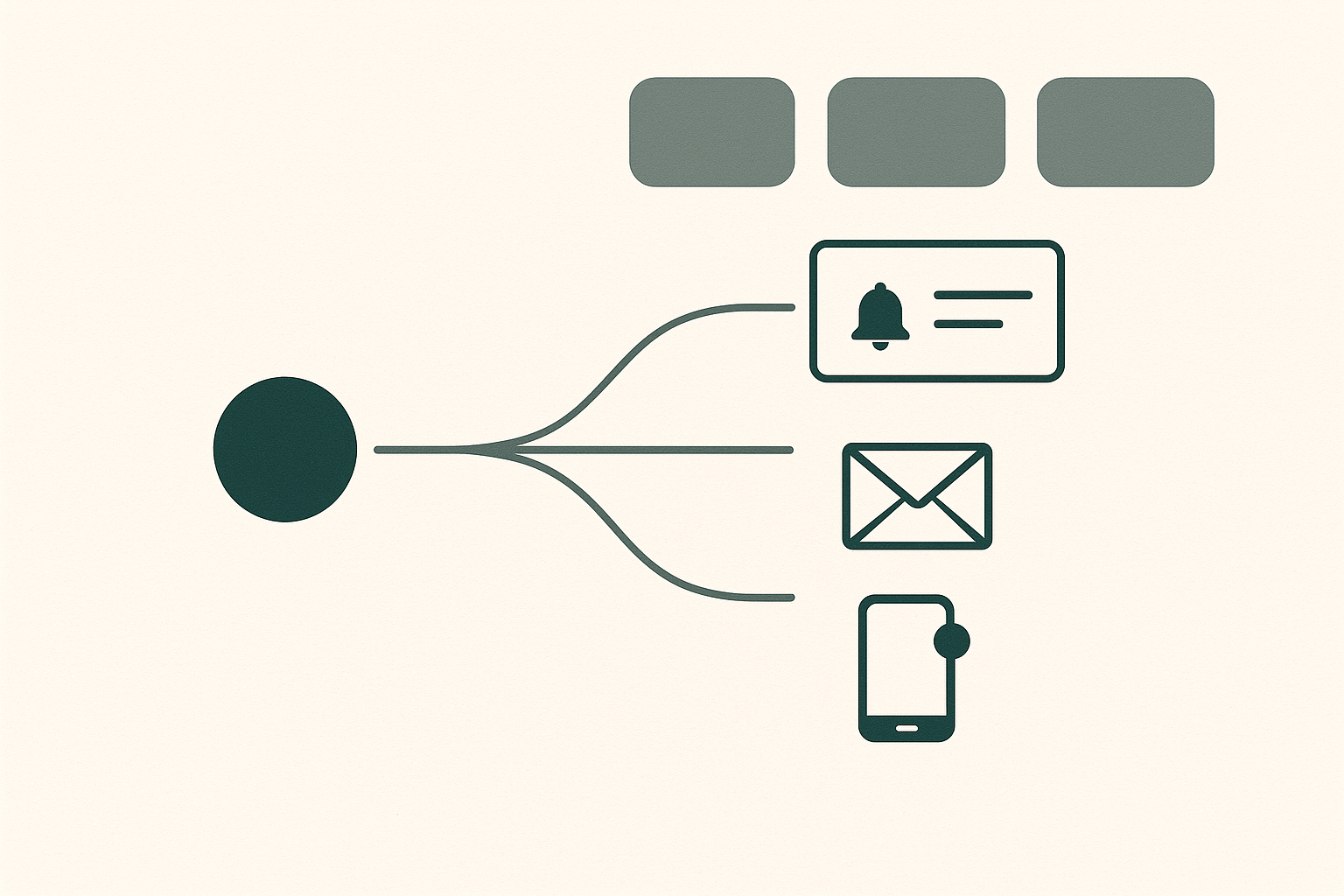
One event routing to in-app inbox, email, and push channels across three notification platforms, ShipGarden, 2026
On this page
The quick answer (2026)
Every SaaS eventually needs to tell users something: a comment reply, a failed payment, a weekly digest. In 2026 the build-or-buy decision for that layer comes down to one question: do you want to own the notification pipe, or rent a managed platform and pay per message?
Novu is the open-source one. MIT-licensed core, self-hostable, and it ships a drop-in `` React component plus a workflow engine that fans one event out to in-app, email, SMS, push, and chat. Most control, and the only option you can run on your own infrastructure.
Knock is a closed-source managed platform built for developers. Clean APIs, a strong in-app feed, and per-recipient preferences handled for you. Fastest polished result if you are happy to outsource the pipe and its data.
Courier is a closed-source managed platform that leans on a visual designer and automations. Great for teams who want product and marketing to shape notifications without shipping code for every change.
We road-test these building blocks so we can own the stack that funds the life, not chase the newest logo. Here is how the three actually differ once you get past the landing pages.
At a glance
Scroll to see more
Tool
Stars (Aug 2026)
License / model
What it is
Can you self-host?
Novu
39.6k
MIT core, separate enterprise license for some features
Open-source notification workflow engine + inbox
Yes, free, MIT core
Knock
Closed source (SDKs only)
Proprietary, managed SaaS
Developer-first managed notification API
No
Courier
Closed source (SDKs only)
Proprietary, managed SaaS
Managed notifications with a visual designer
No
Novu's star count is read from the novuhq/novu GitHub repository in August 2026. Knock and Courier are commercial platforms; their public repositories are client SDKs, not the product, so a star count is not a meaningful signal for them. Every claim below links to its source.
The one decision that actually matters: own the pipe or rent it
Most comparisons rank these three on a channel checklist. All three send in-app, email, SMS, and push, so that table is a wash. The real fork is who runs the infrastructure and who holds the data.
Novu is a pipe you can own. The core is MIT-licensed and you can docker compose up the whole stack on your own box: the API, the workflow engine, the notification store, and the React `` component. That matters when notification content is sensitive, when data residency is a contract requirement, or when you simply do not want a third party holding every message your product sends. Novu also runs a hosted cloud if you would rather not operate it, so it is the one tool here that lets you start managed and move to self-hosted later without a rewrite.
Knock and Courier are pipes you rent. Neither is open-source and neither offers self-hosting: their notifications, preferences, and delivery logs live on their infrastructure. In exchange you never run a queue, a worker, or a notification database. For most teams shipping a Next.js SaaS on Vercel, that trade is exactly right at the start; the question is whether it still fits at 100k users and a compliance review.
If you already know you will need self-hosting or data control, the decision is essentially made: Novu is the only one of the three that can do it. If you know you never want to run this layer, the real comparison is Knock versus Courier on developer experience and price.
Novu: own the whole notification layer
Novu is a TypeScript notification infrastructure that models a notification as a workflow: one trigger fans out to steps across in-app, email, SMS, push, and chat, with per-step delays, digests, and preference checks. You define workflows in code or in its dashboard, then trigger them from your backend with a single API call.
For a Next.js app the headline is the `` React component. You drop it in, point it at a subscriber id, and you have a real in-app notification feed with read state and preferences, without building the bell-menu yourself. Under the hood Novu leans on MongoDB and Redis, which is the honest cost of self-hosting: you are now running those too.
In 2026 Novu repositioned around agent and product communication, but the notification core is the same one that earned its 39.6k GitHub stars: an event goes in, a multi-channel workflow comes out. This is the option we reach for when owning the stack is the point, the same way we treat background jobs as something you self-host rather than rent.
Knock: the developer-first managed platform
Knock treats notifications as a product surface owned by engineers. You send a notify call with a workflow key and recipients, and Knock handles channel routing, batching, per-recipient preferences, and delivery. Its @knocklabs/react package gives you an in-app feed and a preference center that slot into a Next.js app cleanly, and its APIs are the most notification-native of the three.
The pitch is that you never think about the pipe. There is no queue to run, no notification database to migrate, no worker to keep alive. For a small team that wants a polished in-app feed and reliable email plus SMS this week, Knock is often the shortest path. The catch is that everything, including your notification history and user preferences, lives on Knock, and the pricing steps up sharply once you outgrow the free tier (more on that below).
Courier: notifications shaped in a visual designer
Courier's angle is that notification content and logic should not require an engineer for every tweak. Its designer and automation builder let non-engineers lay out templates and branching send logic, while developers trigger sends through the API or SDKs and drop in the @trycourier/react-inbox component for the in-app feed.
That makes Courier a strong fit when product or lifecycle-marketing owns a lot of the messaging and you want them editing content without a deploy. In 2026 Courier also ships an MCP server, CLI, and SDKs so agents and scripts can send through the same pipe. The trade is the same as Knock's: it is closed-source and managed, so you are trusting Courier with the content, the routing, and the logs, and the visual layer is proprietary.
What it costs (August 2026)
Notification pricing is quoted in different units, which makes apples-to-apples hard. Here is the honest read, each figure from the vendor's own pricing page in August 2026.
Scroll to see more
Plan level
Novu
Knock
Courier
Free
$0, 10k workflow runs/mo, all channels
$0, 10k messages/mo
$0, 10k sends/mo
Entry paid
Pro from $30/mo
Starter $250/mo (50k messages, removes branding)
Business, $0.005 per send
Scale
Team from $250/mo
Enterprise, custom
Enterprise, custom
Self-hosted
Free, MIT core (enterprise support paid)
Not available
Not available
Two things stand out. First, the free tiers are close: all three give you roughly 10k notifications a month to start, per Novu, Knock, and Courier. Second, the jump off free differs a lot. Novu's Pro starts at $30/mo and Courier meters at half a cent per send, while Knock's next step is a $250/mo Starter plan. For a side project crossing the free line, that gap is the whole decision. And only Novu has a fourth column: run it yourself for the cost of the servers.
Remember that email and SMS still cost money underneath all three. A notification platform routes and orchestrates; the actual email is sent by a provider you also pay, which is why the email delivery layer is its own comparison.
Where each one loses
No tool wins every row. Here is where each genuinely falls down.
Novu loses on operational burden. Self-hosting means you now run MongoDB and Redis and keep the workflow engine healthy. That is real work, and it is work Knock and Courier delete entirely. Some features sit under a separate enterprise license rather than the MIT core, so "open-source" does not mean every capability is free. And the 2026 pivot toward agent communication means the product surface moves faster than a frozen notifications tool would.
Knock loses on the price cliff and on lock-in. The step from a free plan to a $250/mo Starter is a steep first paid tier for an indie or seed-stage product, and being closed-source with no self-host option means your notification data and preference logic live somewhere you cannot take with you. For a team with data-residency or on-prem requirements, Knock is simply off the table.
Courier loses on developer-native depth and openness. The visual designer is its strength and its weakness: teams that want everything expressed in code and versioned in git can find the designer-first model works against them, and the proprietary automation layer is another thing you do not own. Like Knock, there is no self-host escape hatch.
Which one to pick
Pick Novu if you want to own the notification layer, need self-hosting or data control, or want an open-source `` you can start on the cloud and move in-house later. Accept that you may be running MongoDB and Redis.
Pick Knock if you want the most developer-native managed API and a polished in-app feed with zero infrastructure, and the $250/mo step after the free tier is comfortable when you get there.
Pick Courier if non-engineers will own a lot of the messaging and you want a visual designer plus pay-as-you-go metering rather than a fixed monthly step.
For most Next.js SaaS builders who care about owning their stack, Novu is the default and the managed platforms are the shortcut. Which one is right depends entirely on whether running the pipe is a cost you want to carry or one you want to delete.
FAQ
Is Novu really open-source?
The Novu core is MIT-licensed and you can self-host it for free, including the API, workflow engine, and the React `` component. Some enterprise features sit under a separate LICENSE-ENTERPRISE rather than the MIT core, so it is open-core rather than fully permissive across every feature. Novu also runs a hosted cloud with a free tier of 10k workflow runs per month (August 2026).
Can I self-host Knock or Courier?
No. As of August 2026 both Knock and Courier are proprietary, managed-only platforms with no self-hosting option. Your notifications, preferences, and delivery logs live on their infrastructure. If self-hosting or data residency is a requirement, Novu is the only one of the three that qualifies.
Do these replace my email provider like Resend or SendGrid?
No. Novu, Knock, and Courier orchestrate and route notifications across channels, but the actual email is still delivered by a provider such as Resend, SendGrid, Postmark, or SES, which you configure and pay for separately. See our email delivery comparison for that layer.
Which is cheapest for a small Next.js SaaS?
All three start free at roughly 10k notifications per month (August 2026). Off the free tier, Courier meters at $0.005 per send and Novu's Pro plan starts at $30/mo, while Knock's next step is a $250/mo Starter plan. For a low-volume product just crossing the free line, Novu or Courier are usually cheaper; Novu self-hosted is cheapest of all if you can run the servers.
What do all three add to a Next.js app?
Each ships a React component for an in-app notification feed (Novu's ``, Knock's @knocklabs/react, Courier's @trycourier/react-inbox) plus a server-side API you call from your backend to trigger a multi-channel notification. The difference is who runs the infrastructure behind that component and whether you can host it yourself.
Stars, versions, licenses, and prices in this guide were read from each project's GitHub repository and official pricing pages in August 2026. Notification platforms iterate quickly; verify current numbers against the source links before you commit.
Yui Tanaka curates the ShipGarden gallery, where we test open-source building blocks so we can own the stack that funds the life.
Frequently asked questions
Is Novu really open-source?
The Novu core is MIT-licensed and you can self-host it for free, including the API, workflow engine, and the React Inbox component. Some enterprise features sit under a separate LICENSE-ENTERPRISE rather than the MIT core, so it is open-core rather than fully permissive across every feature. Novu also runs a hosted cloud with a free tier of 10k workflow runs per month (August 2026).
Can I self-host Knock or Courier?
No. As of August 2026 both Knock and Courier are proprietary, managed-only platforms with no self-hosting option. Your notifications, preferences, and delivery logs live on their infrastructure. If self-hosting or data residency is a requirement, Novu is the only one of the three that qualifies.
Do these replace my email provider like Resend or SendGrid?
No. Novu, Knock, and Courier orchestrate and route notifications across channels, but the actual email is still delivered by a provider such as Resend, SendGrid, Postmark, or SES, which you configure and pay for separately.
Which is cheapest for a small Next.js SaaS?
All three start free at roughly 10k notifications per month (August 2026). Off the free tier, Courier meters at $0.005 per send and Novu's Pro plan starts at $30/mo, while Knock's next step is a $250/mo Starter plan. For a low-volume product just crossing the free line, Novu or Courier are usually cheaper; Novu self-hosted is cheapest of all if you can run the servers.
What do all three add to a Next.js app?
Each ships a React component for an in-app notification feed (Novu's Inbox, Knock's @knocklabs/react, Courier's @trycourier/react-inbox) plus a server-side API you call from your backend to trigger a multi-channel notification. The difference is who runs the infrastructure behind that component and whether you can host it yourself.
Resend, SendGrid, Postmark and Amazon SES compared on real 2026 pricing, free tiers, deliverability, and the open-source react-email layer, with a decision guide for Next.js SaaS builders.
Most people searching for a Node.js workflow engine are holding two problems at once. We split the shelf along that seam: job queues (BullMQ, pg-boss) on one side, workflow engines with durable execution (Hatchet, Trigger.dev, Temporal, Inngest) on the other, and the test that tells you which one you need.
Appsmith, ToolJet, and Budibase are the open-source answer to Retool. We compare the three self-hostable internal tools builders for a Next.js SaaS in 2026, split honestly by license and by weight.
 Novu
Novu Knock
Knock Courier