Neon vs Supabase vs Xata vs Nile: serverless Postgres for a Next.js SaaS in 2026
Serverless Postgres is four different bets in 2026, not one. A ShipGarden curator's source-checked guide to Neon, Supabase, Xata, and Nile for a Next.js SaaS: branching, real pricing, multi-tenancy, and where each one loses.
Updated on July 29, 2026
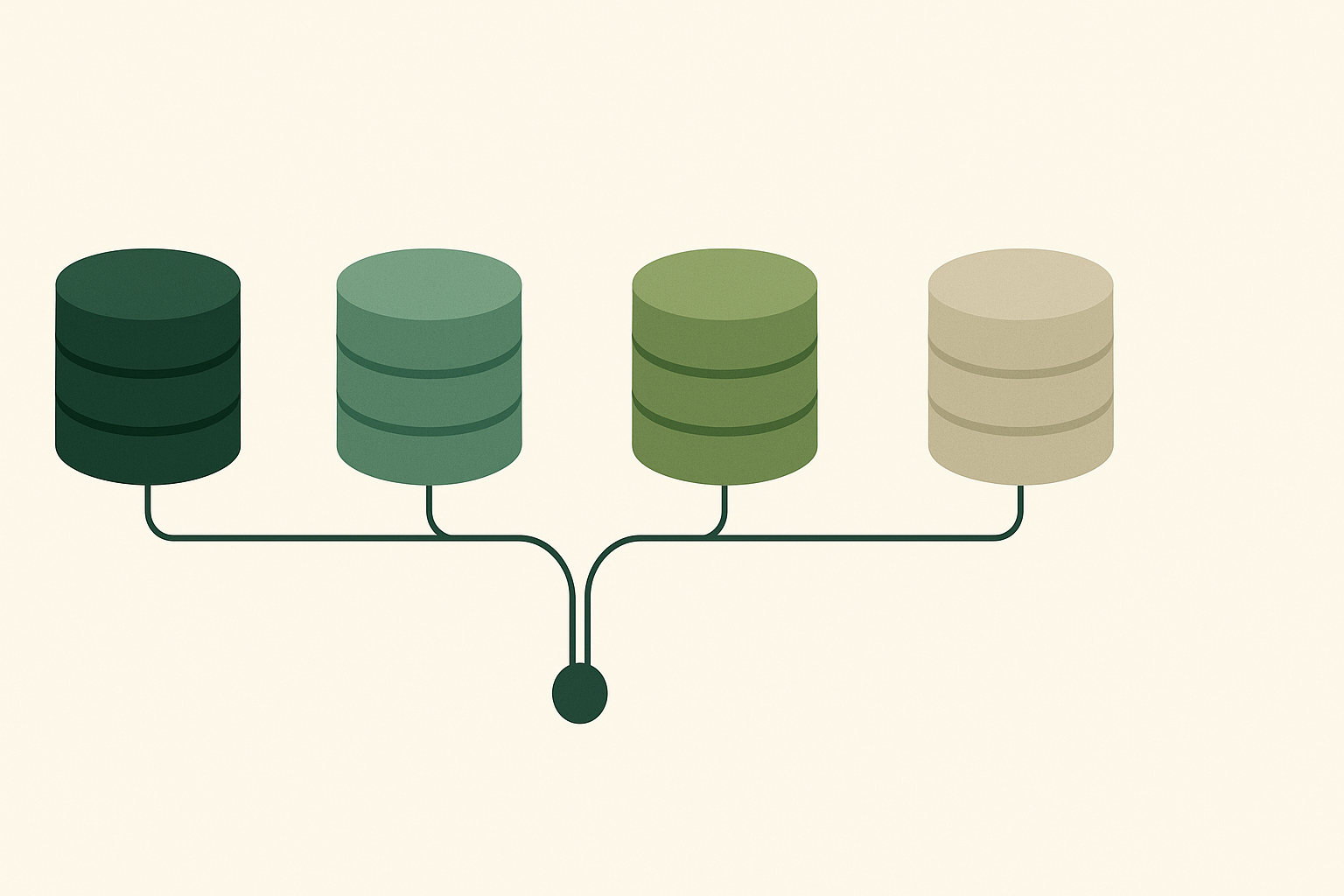
Four serverless Postgres databases branching from a central node, ShipGarden gallery illustration, 2026
On this page
Quick answer (July 2026)
If you are choosing the Postgres host for a Next.js SaaS starter in 2026, "serverless Postgres" is no longer one decision. It is four different bets, and they optimize for different problems:
Neon is the branch-per-preview default: pure serverless Postgres that scales to zero when idle and bills pay-as-you-go, with instant git-style branching (neondatabase/neon, 2026).
Supabase is the backend-in-a-box: Postgres plus auth, storage, realtime, and edge functions wired together on day one (supabase/supabase, 2026).
Xata is the one that quietly reinvented itself: it dropped its old proprietary data API and is now 100 percent upstream Postgres focused on copy-on-write branching and scale-to-zero (xata.io, 2026).
Nile is Postgres re-engineered for multi-tenant B2B: one physical database that hosts unlimited virtual tenant databases with per-tenant isolation baked in (niledatabase on GitHub, 2026).
The short version: pick Neon for a clean database with the best branching workflow, Supabase when you want half your backend to already exist, Xata when branching economics are the whole game, and Nile when your app is multi-tenant from row one. The rest of this piece shows exactly where each of those bets pays off, and where it costs you.
Why serverless Postgres is four bets now, not one
We clone a lot of open-source starters here at ShipGarden, and for two years the database question had a boring answer: Neon or Supabase, pick your religion. In 2026 that framing is too small. Two things changed it.
First, Xata pivoted. The Xata most comparison posts still describe was a proprietary "Postgres plus search plus a typed data API" product. That Xata is gone. The 2026 Xata runs vanilla upstream Postgres with no proprietary API and sells one thing hard: copy-on-write branching that clones a production-size database in seconds without paying for a second copy (xata.io, 2026). If your mental model of Xata is more than a year old, throw it out.
Second, Nile made multi-tenancy a first-class database feature instead of a schema pattern you hand-roll. Almost every B2B SaaS eventually asks the same question: how do I keep Tenant A's data isolated from Tenant B without spinning up a database per customer? Nile's answer is tenant virtualization, where one physical Postgres holds unlimited logical tenant databases and the isolation is enforced for you (thenile.dev, 2026).
So the honest 2026 question is not "Neon or Supabase." It is: do you want a database, a backend, cheap branching, or native multi-tenancy? Those are four answers, and only one of them is on most people's radar.
The 2026 facts, side by side
Every figure below came from each project's own repository or pricing page this month, and it is year-tagged so you can re-check it.
Neon is the one most 2026 Next.js starters reach for, and the reason is database branching. Neon spins up a full copy-on-write branch of your database the way git branches your code, and the free tier includes 10 branches per project (neon.com/pricing, 2026). Wire that into your Next.js preview deploys and every pull request gets its own isolated database with production-like data, then throws it away on merge.
Its second trick is scale-to-zero. Because storage and compute are separated, an idle Neon database parks its compute after about five minutes and costs almost nothing until the next request wakes it. And the pricing changed this year: Neon's paid plans are now purely pay-as-you-go with no monthly minimum, metered at roughly $0.106 per compute-hour on Launch plus $0.35 per GB-month of storage (neon.com/pricing, 2026). If you still quote Neon's old "$19 Launch plan," that number is stale.
Supabase: Postgres with the backend already bolted on
Supabase is not really a database pick; it is a backend pick. Postgres sits at the center, but around it you get hosted auth, row-level security wired to your Postgres roles, storage buckets, realtime channels, and edge functions, all sharing one project (supabase.com/pricing, 2026). For a solo founder racing to a first paying customer, "my auth and my database already understand each other" is worth real time.
The paid math is refreshingly boring, which is a compliment. Pro is a flat $25 per month and includes 8 GB of database disk, 100,000 monthly active users, and a database that never pauses, unlike the free tier that sleeps after a week of inactivity (supabase.com/pricing, 2026). A predictable invoice line is a feature when you are modeling runway. If you are weighing the full backend-as-a-service field rather than raw Postgres, we line those up in Convex vs Supabase vs Firebase.
Xata: the one that quietly reinvented itself
This is the section most current comparisons get wrong. Xata's whole pitch in 2026 is branching economics on 100 percent upstream Postgres. It uses copy-on-write so a branch shares data with its parent instead of duplicating it, which Xata says cuts the cost of full replicas by a large margin, and idle branches hibernate and use no compute until a query wakes them (xata.io, 2026).
The commercial model matches the pitch: Xata explicitly does not bill per user or per branch, and Xata Cloud is pay-as-you-go, roughly $0.012 per hour of compute plus $0.28 per GB-month of storage, with instances that start around $9 per month for a micro and scale up from there (xata.io/pricing, 2026). There is also a self-hostable open-source path and a bring-your-own-cloud option for teams with compliance needs. If your bottleneck is "we clone the production database constantly and the copies are eating the budget," Xata is built precisely for that pain. Xata's own engineering write-up on how the three branching models differ is a genuinely good read (Neon vs Supabase vs Xata branching, Xata, 2025).
Nile: the one built for multi-tenant B2B
Nile is the outlier here, and the most interesting if you are building B2B. Instead of you designing a tenant_id column strategy and praying your queries never leak across customers, Nile makes the tenant a first-class database primitive: one physical Postgres hosts unlimited virtual tenant databases, and per-tenant isolation, backups, and even per-tenant vector embeddings for RAG are handled by the platform (thenile.dev, 2026).
The free tier is generous for a serverless database that never pauses: 1 GB of storage, 50 million query tokens, 500 connections, and unlimited tenants and databases, with Pro at $15 per month lifting you to 150 million query tokens, 5 GB, 10,000 connections, and a 99.95 percent uptime SLA (thenile.dev pricing, 2026). If your product is single-tenant, all of this is machinery you do not need. If it is multi-tenant, Nile removes the single most error-prone part of the schema.
The decision, by what your SaaS actually needs
Skip the brand loyalty and answer one question about your app:
You want the cleanest branch-per-preview workflow and a bill that rewards idleness. Neon. It set the standard for git-style branching and pay-as-you-go metering.
You want half your backend to exist the moment you create the project. Supabase. Auth plus storage plus realtime plus Postgres in one dashboard.
You clone production data constantly and the copies are the cost problem. Xata. Copy-on-write branching with no per-branch or per-user billing is the entire product.
Your app is multi-tenant B2B from the first customer. Nile. Native tenant isolation beats hand-rolling tenant_id on every table.
Notice that only Neon and Supabase are genuinely interchangeable. Xata and Nile are not "also-rans" in that race; they win a different race entirely, which is exactly why the two-way framing misses them.
Where each one loses (honest, all four directions)
We do not publish one-sided reviews, so here is the uncomfortable half.
Where Neon loses. It is only a database. You wire up auth, storage, and background jobs yourself. Pure pay-as-you-go can feel unpredictable for an always-on workload that never idles.
Where Supabase loses. The free tier pauses after a week of inactivity, a real trap for demos and staging. It is a bigger surface to learn and to trust, with more platform opinions and more lock-in if you lean on its auth and storage.
Where Xata loses. It is the youngest positioning of the four, and its 2025 pivot means the community, tutorials, and third-party content are still catching up to what the product actually is today. If you are not clone-heavy, its headline advantage does not apply to you.
Where Nile loses. It is a specialist. If your app is single-tenant, its multi-tenant machinery is overhead you will never use, and its ecosystem is the smallest of the four. Betting on a focused vendor for your core datastore is a real risk to weigh.
Which starter should pick which
AI app or B2B tool with spiky, sleep-at-night traffic: Neon, for scale-to-zero and branch-per-preview.
Solo founder racing to the first paying customer: Supabase, for the day-one backend.
A team whose CI clones the production database on every branch: Xata, for copy-on-write economics.
A multi-tenant B2B SaaS that must isolate customers cleanly: Nile, for native tenant isolation.
Greenfield, single-tenant, no strong opinion: lean Neon if you will bring your own auth, lean Supabase if you want half the backend done for you today.
For the starters we track, our open-source Next.js SaaS and AI scorecard shows the same split in practice: speed-to-first-customer starters lean Supabase, control-and-cost starters lean Neon, and the branching-heavy and multi-tenant teams are the ones now reaching for Xata and Nile.
FAQ
What is the difference between Neon, Supabase, Xata, and Nile in 2026?
All four are serverless Postgres, but they optimize for different jobs. Neon is a focused serverless Postgres with instant branching and scale-to-zero. Supabase is a full backend platform (auth, storage, realtime, functions) built around Postgres. Xata is upstream Postgres focused on cheap copy-on-write branching. Nile is Postgres re-engineered for multi-tenant B2B, with per-tenant isolation as a first-class feature.
Is Xata still a good choice after it changed products?
Yes, but know what you are buying. The 2026 Xata is not the old proprietary data-API product; it is 100 percent upstream Postgres focused on copy-on-write branching and scale-to-zero, and it explicitly does not bill per user or per branch. It is strongest for teams that clone production databases constantly and want those copies to be cheap.
Which serverless Postgres is best for a multi-tenant SaaS?
Nile is purpose-built for it. One physical Postgres hosts unlimited virtual tenant databases with isolation, backups, and per-tenant vector embeddings handled for you, so you avoid hand-rolling a tenant_id strategy across every table. Neon and Supabase can do multi-tenancy, but you design and enforce the isolation yourself.
How much do these cost in 2026?
All four have a free tier. Supabase Pro is a flat $25 per month; Nile Pro is $15 per month; Neon and Xata are pay-as-you-go with no monthly minimum, with Xata Cloud instances starting around $9 per month for a micro. Usage-based math varies by workload, so check each pricing page for live numbers.
Can I self-host any of them?
Neon and Supabase are open source (Apache-2.0) and self-hostable, and Xata offers an open-source self-host path plus a bring-your-own-cloud option. In practice most teams use the managed cloud because operating storage-compute separation or multi-tenant virtualization yourself is a lot of work.
Does branching work the same across Neon, Supabase, and Xata?
No. Neon pioneered instant git-style copy-on-write branches and makes them central. Xata also uses copy-on-write branching as its core pitch, with idle branches that hibernate. Supabase offers preview and database branches integrated into its platform, but branching there is more platform-tied and newer than on Neon or Xata.
Your move: write down one sentence describing your app's data shape, spiky-and-idle, backend-heavy, clone-heavy, or multi-tenant, then create a free project on the one that matches. Point a throwaway Next.js branch at it, run your ugliest migration, and see if the workflow felt obvious in twenty minutes. That answer is worth more than any table, including this one.
Mara Lindqvist curates the ShipGarden gallery, road-testing open-source and source-available SaaS and AI boilerplates and the infrastructure they run on. She writes about time-to-first-deploy, cost, and vendor lock-in for founders who ship.
Frequently asked questions
What is the difference between Neon, Supabase, Xata, and Nile in 2026?
All four are serverless Postgres, but they optimize for different jobs. Neon is a focused serverless Postgres with instant branching and scale-to-zero. Supabase is a full backend platform (auth, storage, realtime, functions) built around Postgres. Xata is upstream Postgres focused on cheap copy-on-write branching. Nile is Postgres re-engineered for multi-tenant B2B, with per-tenant isolation as a first-class feature.
Is Xata still a good choice after it changed products?
Yes, but know what you are buying. The 2026 Xata is not the old proprietary data-API product; it is 100 percent upstream Postgres focused on copy-on-write branching and scale-to-zero, and it explicitly does not bill per user or per branch. It is strongest for teams that clone production databases constantly and want those copies to be cheap.
Which serverless Postgres is best for a multi-tenant SaaS?
Nile is purpose-built for it. One physical Postgres hosts unlimited virtual tenant databases with isolation, backups, and per-tenant vector embeddings handled for you, so you avoid hand-rolling a tenant_id strategy across every table. Neon and Supabase can do multi-tenancy, but you design and enforce the isolation yourself.
How much do these cost in 2026?
All four have a free tier. Supabase Pro is a flat $25 per month; Nile Pro is $15 per month; Neon and Xata are pay-as-you-go with no monthly minimum, with Xata Cloud instances starting around $9 per month for a micro. Usage-based math varies by workload, so check each pricing page for live numbers.
Can I self-host any of them?
Neon and Supabase are open source (Apache-2.0) and self-hostable, and Xata offers an open-source self-host path plus a bring-your-own-cloud option. In practice most teams use the managed cloud because operating storage-compute separation or multi-tenant virtualization yourself is a lot of work.
Does branching work the same across Neon, Supabase, and Xata?
No. Neon pioneered instant git-style copy-on-write branches and makes them central. Xata also uses copy-on-write branching as its core pitch, with idle branches that hibernate. Supabase offers preview and database branches integrated into its platform, but branching there is more platform-tied and newer than on Neon or Xata.
Neon or Supabase for your Next.js SaaS starter in 2026? A curator's honest, source-checked head-to-head: it is not two databases, it is a database vs a whole backend. Branching, scale-to-zero, the pricing that changed, and where each one loses.
Convex, Supabase, and Firebase are three different bets on your data model and how much you own. A sourced 2026 comparison of free tiers, real costs, lock-in, and which backend fits your Next.js build.
A hands-on July 2026 scorecard of ten open-source and source-available Next.js SaaS and AI starters, ranked across six axes with real GitHub stars and exact licenses.


 Neon
Neon Supabase