Langflow vs Flowise: the open-source visual AI agent builder for a Next.js stack (2026)
Langflow and Flowise are the two big open-source visual AI agent builders in 2026. We compare them for a Next.js team: Python vs Node, how each connects to your app, licensing, backing, and where each loses.
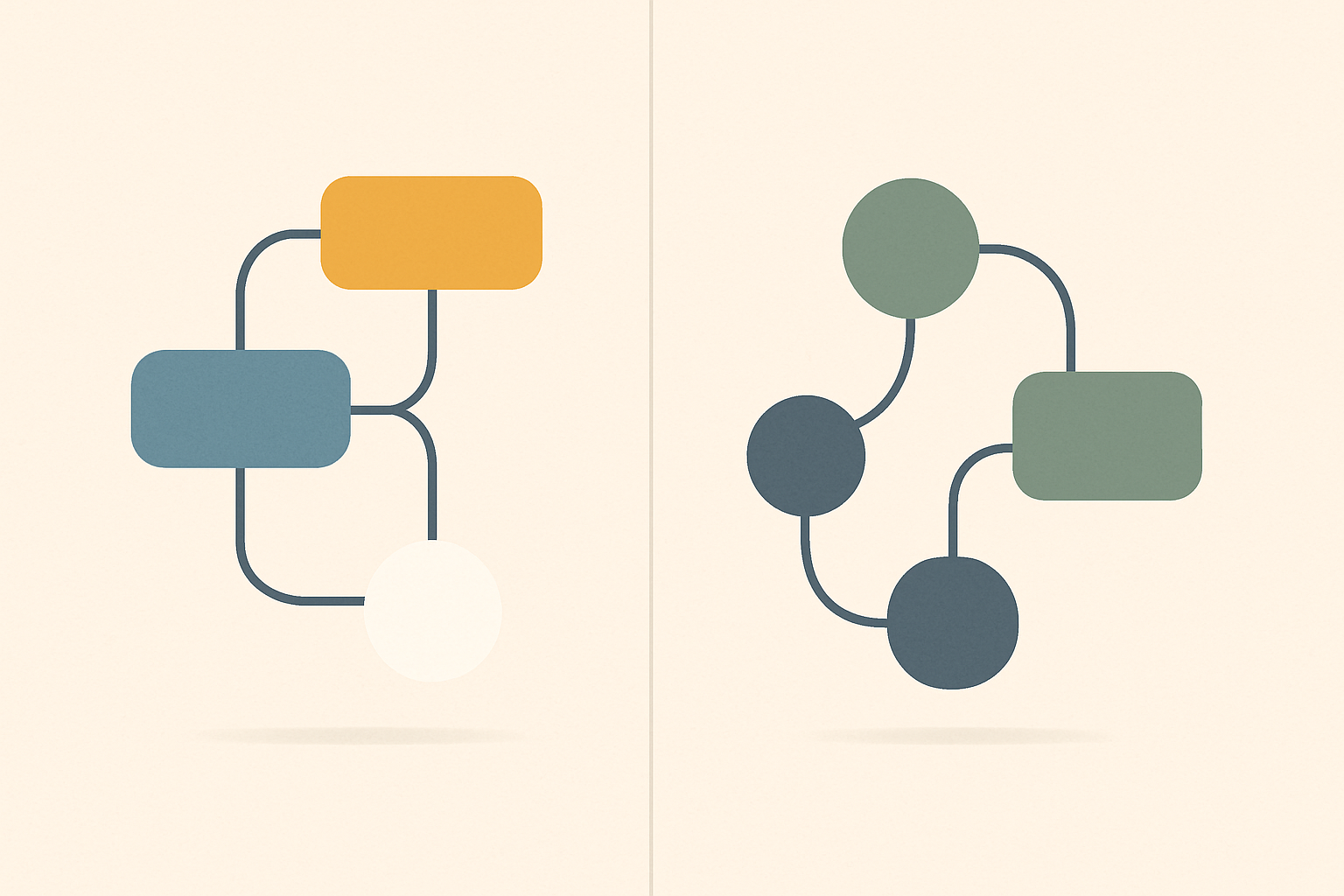
Two abstract flow-diagram canvases side by side, one with blue and yellow nodes and one with green and slate nodes, representing the Langflow and Flowise visual AI agent builders
On this page
The quick answer (2026)
If you are choosing a visual, open-source AI agent builder to sit next to a Next.js app in 2026, the decision is mostly about one thing: which language your team already writes. Both tools draw the same kind of drag-and-drop flow of models, prompts, tools, and retrievers, and both are genuinely open source. The split is underneath the canvas.
Langflow is a Python application (FastAPI plus a React editor). Pick it when your agent and retrieval logic already live in Python, or when you want the deepest LangChain-style component library and do not mind operating a Python service beside your Node app.
Flowise is a Node.js and TypeScript application. Pick it when your stack is already JavaScript end to end, you want to read and extend the builder in the same language as your Next.js app, or you need a drop-in embeddable chat widget fast.
Neither one compiles into your Next.js build and neither runs on Vercel serverless. Both run as a separate service you talk to over an API. So the second real question, after language, is how each one connects back to your app. We road-test these building blocks so we can own the stack that funds the work, not chase the newest logo. Here is how the two actually differ once you get past the demo GIFs.
At a glance
Scroll to see more
Tool
Stars (Aug 2026)
License
Built with
Runs as
Backed by
Langflow
153k
MIT
Python (FastAPI) + React
A Python service on port 7860
langflow-ai, now inside IBM (via DataStax)
Flowise
55.3k
Apache-2.0
Node.js + TypeScript + React
A Node.js service you run with npx
FlowiseAI (independent)
Star counts, licenses, and stacks are read from each project's GitHub repository in August 2026. Nothing here is invented; every claim links to its source in the Sources block below.
The one decision that actually matters: the language your stack already speaks
Most comparisons rank these two on feature checklists. That buries the fork that will actually shape your week. For a Next.js and TypeScript team, the deciding difference is the runtime each tool drags in.
Langflow is a Python program. You install it with uv pip install langflow and start it with uv run langflow run, and it needs Python 3.10 to 3.14 as of August 2026. Under the hood it grew out of the Python LangChain ecosystem, so its component palette is broad and its flows map cleanly onto Python agent code. If your embeddings, chunking, and tool-calling already live in a Python service, Langflow feels native and you can export a flow to Python to keep going in code.
Flowise is a Node program. You install it with npm install -g flowise and start it with npx flowise start, and it needs Node.js 20 or newer. It is written in TypeScript on top of the JavaScript LangChain and LlamaIndex libraries. For a team whose entire product is already Node and TypeScript, that matters more than any feature cell: you can read the builder's source, extend a node in the same language as your app, and share types and utilities instead of maintaining a second runtime.
Put plainly: Langflow asks a JavaScript shop to run and operate a Python service. Flowise asks a Python shop to run and operate a Node service. Everything else being close, the tool that speaks your existing language is the one your team will actually maintain a year from now.
How each one connects to a Next.js app
Because both run as a separate service, you never import them into a Next.js route. You call them. This is the same pattern we flag on every server-side builder in the gallery: run it as a sibling service, integrate at the API layer.
Scroll to see more
Integration path
Langflow
Flowise
Call a flow from your server
REST endpoint per flow (run it from a Next.js Route Handler or Server Action)
Prediction API endpoint per flow, plus a TypeScript SDK
Drop a chatbot into your UI
Available via the API; you build the widget
Built-in embeddable chat widget you add with a script tag
Where it runs
Self-host the Python service, or use the hosted cloud
Self-host the Node service, or use managed Flowise Cloud
Reuse in your codebase
Export a flow to Python
Same-language nodes and SDK in TypeScript
The practical read: if what you want is a support or docs chatbot bolted onto a Next.js marketing site this afternoon, Flowise's embeddable widget is the shortest path, and its SDK is in your language. If instead you plan to build the chat interface yourself in React, the UI layer is a separate decision we break down in our agent-UI comparison. If what you want is a richer retrieval-and-agent backend that your Python team will keep growing, Langflow's export-to-Python path and larger component library pull ahead. Whichever builder draws the flow, retrieval quality still comes down to your vector store and chunking strategy, which we road-test in our TypeScript RAG starter review.
Licensing: both are genuinely open source
This is where these two are cleaner than a lot of the "open-source" AI tooling shipping in 2026. Langflow is MIT licensed. Flowise is Apache-2.0 licensed. Both are OSI-approved, both let you self-host commercially, and neither carries the "you may not offer this as a service" restriction that the fair-code and source-available crowd attach to their licenses. If you were burned by a source-available workflow tool's usage clause, that whole category of worry does not apply here.
The one nuance worth knowing: Apache-2.0 (Flowise) includes an explicit patent grant and a notice requirement, which some legal teams prefer for commercial use; MIT (Langflow) is shorter and even more permissive. Neither difference is a reason to pick a tool on its own, but if your counsel has a house preference between MIT and Apache-2.0, it is already satisfied by one of these.
Who is behind each, and why longevity is a real axis
A visual builder is infrastructure you will depend on, so who maintains it matters as much as the node count.
Langflow started as Logspace's open-source project (first released in early 2023), was acquired by DataStax in April 2024, and came under IBM when IBM's acquisition of DataStax closed on May 28, 2025. As of August 2026 it is maintained inside IBM and folded into the watsonx AI portfolio, and it still ships a free hosted cloud alongside the MIT self-host build. That is deep-pocketed, enterprise-grade governance, with the usual trade-off that the roadmap now answers to a large vendor.
Flowise is maintained by the independent company FlowiseAI, which funds development partly through a managed Flowise Cloud for teams that would rather not self-host. That means a smaller, more focused team moving quickly and closer to its community, with the usual independent-project trade-off around long-term resourcing.
Both are healthy and actively developed. If "will this still be maintained in three years" weighs heavily, Langflow's IBM backing is reassuring; if you value a nimble project that ships fast and takes community pull requests, Flowise's independence is the point.
Where each one loses
We keep an honest ledger, because a comparison that only lists strengths is a brochure.
Langflow loses when your stack is pure Node and you have no appetite to run, patch, and monitor a Python service in production. It is the heavier of the two to operate, its visual editor has historically been criticized for getting sluggish on very large flows, and its sweet spot is prototype-then-export rather than "run the canvas as your production engine forever."
Flowise loses when you outgrow the fast-start phase. Independent production write-ups in 2026 are candid that Flowise gets you working quickly but is not designed for the "and then we scaled it to 10,000 users" moment without real work on queues, multi-tenancy, and observability. Its component ecosystem is also narrower than Langflow's LangChain-heritage palette, and some team-scale features live in the paid Flowise Cloud rather than the open-source core.
So which should you ship?
Scroll to see more
Pick
When
Langflow
Your agent and retrieval logic already live in Python, you want the widest LangChain component library, you plan to export flows to Python code, or you want IBM-backed governance and a free hosted cloud
Flowise
Your product is already Node and TypeScript, you want to read and extend the builder in your own language, or you need a drop-in embeddable chat widget on a Next.js site quickly
Both are legitimate, genuinely open-source ways to build agent and retrieval flows visually, and both sit outside your Next.js build as a service you call. Start from the language your team already speaks, weigh how much you need an embeddable widget versus a deep Python component library, and let the honest losing-cases above break the tie. When a visual flow graduates into something you want to own in code, that is the moment to look at a code-first TypeScript agent framework instead of a canvas.
Mara Lindqvist curates the ShipGarden gallery, road-testing open-source and source-available SaaS and AI boilerplates and the infrastructure they run on. She writes about time-to-first-deploy, cost, and vendor lock-in for founders who ship.
Frequently asked questions
Should I use Langflow or Flowise for a Next.js app in 2026?
Start from the language your stack already uses. Choose Flowise if your product is Node and TypeScript, because it is written in the same language, ships a TypeScript SDK, and has a drop-in embeddable chat widget. Choose Langflow if your agent and retrieval logic is Python or you want the larger LangChain component library. Either way, both run as a separate service you call over an API; neither compiles into your Next.js build or runs on Vercel serverless.
Are Langflow and Flowise free?
Both are free and open source to self-host. Langflow is MIT licensed and Flowise is Apache-2.0 licensed, and neither license restricts commercial self-hosting. Langflow also offers a free hosted cloud, while FlowiseAI offers a paid managed Flowise Cloud for teams that prefer not to self-host.
What is the difference between Langflow and Flowise under the hood?
Langflow is a Python application (FastAPI plus a React editor) that grew out of the Python LangChain ecosystem and needs Python 3.10 to 3.14. Flowise is a Node.js and TypeScript application built on the JavaScript LangChain and LlamaIndex libraries and needs Node.js 20 or newer. That language split is the main practical difference for a developer choosing between them.
Which has more community momentum, Langflow or Flowise?
As of August 2026, Langflow has about 153k GitHub stars and Flowise about 55.3k. Langflow has more stars and is now maintained inside IBM (which acquired DataStax, Langflow's owner, in May 2025); Flowise is an independent project with a smaller, focused team. More stars is momentum, not fit: for a Node team, Flowise's same-language codebase can matter more than raw star count.
Can I embed a Langflow or Flowise chatbot into a Next.js site?
Flowise ships a built-in embeddable chat widget you add with a script tag, plus a TypeScript SDK, so it is the faster path to a chatbot on a Next.js site. Langflow exposes each flow as a REST endpoint, so you can call it from a Next.js Route Handler or Server Action, but you build the chat UI yourself.
CopilotKit, assistant-ui, and Vercel AI SDK UI sit at three different layers of the stack. A hands-on 2026 guide to picking the right open-source AI chat UI for your Next.js SaaS.
Hands-on June 2026 review of the LlamaIndex.TS RAG starter for Next.js. The starter still works, the project is officially deprecated, and the deploy-paths matrix below has three options that still ship. Honest cost numbers, vector store picks, and what to point a fresh codebase at instead.
 Langflow
 Flowise